What changed on November 29. Musk added his voice to the rumor, and a group of 21 cryptographers has set up a way to review potential breakthroughs and advise on disclosure. Wait for verifiable evidence and guidance from the affected provider before acting on a viral warning.
Musk Confirms He’s Heard the Rumor That AI Cracked RSA-2048
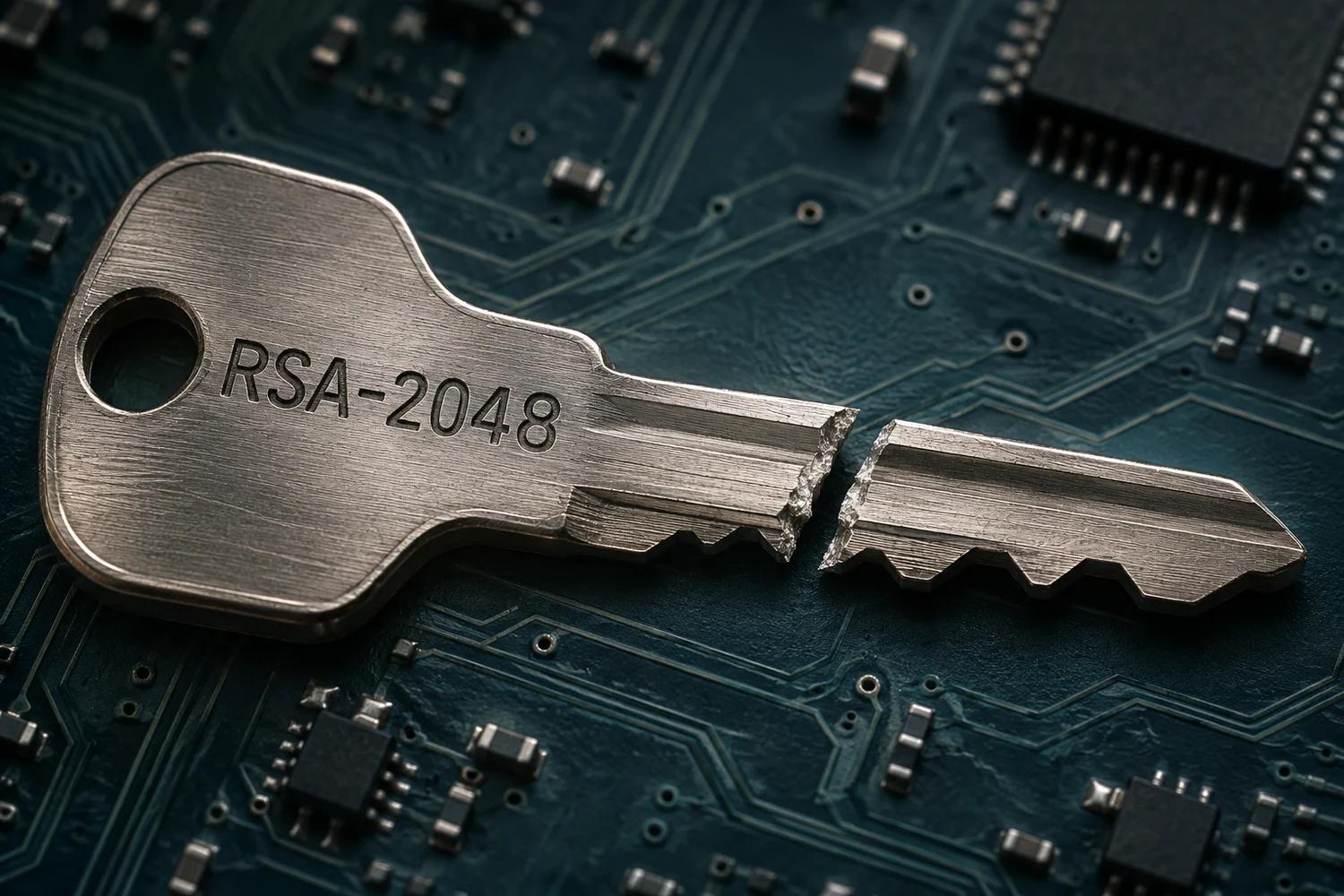
Elon Musk says he has heard the claim that a leading AI lab broke RSA-2048, a widely used form of cryptography. As of November 30, 2026, we found no public demonstration of a practical break. If one were, the fallout could reach software updates, website certificates and years of stored email.
Jump to a section
“I’ve heard this from a few people,” Elon Musk wrote on X at 17:40 UTC on November 29. The claim in the thread, posted the day before by Franz Bruckhoff, was that a leading AI lab might have cracked RSA-2048. Musk supplied no evidence and did not identify his sources. We do not know whether the people repeating the claim heard it independently. Musk’s original reply on X · Archived exchange.
Imagine your phone offers you a security update tomorrow. You tap install because you trust the company that signed it. Now imagine that someone could produce a signature your device would accept as that company’s. That hypothetical is why a practical RSA break would matter well beyond Bitcoin. For systems that still rely on RSA signatures, the question would be whether they could trust the very updates meant to fix them.
What the cryptographers have actually said
The Cryptography Incident Review Group lists 21 members, including Stanford’s Dan Boneh and Johns Hopkins’ Matthew Green. Its stated job is to review advances in breaking cryptographic protections and advise on how to notify affected organizations. As of November 29, the group lists its first statement as forthcoming and has named no broken system. It has not publicly tied its formation to a specific finding.
In a satirical blog dialogue published November 27, computer scientist Scott Aaronson distinguished a theoretical result he said he knew about from more alarming rumors. He said the result he was referring to posed no imminent danger to deployed cryptography and that he lacked specific, actionable information about a practical break. Coinbase separately said on November 28 that it had seen no evidence of an immediate practical threat. Our earlier coverage traced the separate claims about RSA, Bitcoin and post-quantum security. Aaronson’s post · Coinbase’s assessment.
There is real research behind the attention. In September, cryptographer Steve Weis reported using Claude to help factor a smaller, 896-bit challenge number. The computation ran over ten days across a fleet of GPUs. Weis said the work did not materially improve the underlying method or change the security of deployed RSA-2048 keys. That is a concrete result with a defined limit. The November claim has no comparable public evidence. Weis’s research note.
What would count as proof?
For the claim of a practical break, look for a result that independent cryptographers can verify against properly generated 2,048-bit keys, with a clear account of the time and computing resources required. A mathematical paper can be a genuine advance and still describe a method too expensive to threaten deployed keys. For anyone responsible for a system that uses RSA, the next question is which key sizes and real deployments the result affects.
If RSA-2048 really fell, what would be exposed?
RSA-2048 is a way to use a public key and a private key for encryption or for digital signatures. One of its protections is that the large number in a properly generated public key is extremely hard to split back into its prime factors. A method that could do this reliably at a practical cost to ordinary RSA-2048 keys would let an attacker work out the matching private keys. How much that mattered would depend on the time and computing power needed and where the affected keys were used. RSA standard.
| Where RSA is used | What a practical break could expose |
|---|---|
| Website certificates | Someone who could recover a trusted RSA certificate’s private key could impersonate the website if they could intercept a connection. The certificate key alone would not unlock past TLS 1.3 sessions that used ephemeral key exchange. TLS 1.3 standard. |
| SSH access | Affected RSA user keys could allow unauthorized sign-ins where those keys are trusted for access. If additional authentication is required, the key alone may be insufficient. Affected RSA host keys could also undermine confidence that you are connecting to the right server. IETF SSH key standard. |
| Software updates | A forged RSA signature could make tampered software pass a device’s signature check. Other controls could still block installation. NIST code-signing guidance. |
| Email and recorded traffic | Previously captured messages encrypted to an affected RSA key could become readable. Old network traffic could also be exposed where RSA protected the session keys and the connection lacked forward secrecy. OpenPGP standard · IETF guidance on legacy TLS. |
For banks and governments, exposure would depend on where affected keys are still used. An older device or a long-lived archive can face a very different risk from a public-facing service using modern protocols. A new key can protect future communications. It cannot change how someone’s copy of an old message was encrypted.
What a break specific to RSA would leave untouched
A practical result against RSA-2048 would leave an open question about larger RSA keys, including RSA-4096. That would depend on how well the method scales. RSA factoring would have no direct effect on AES-256 encryption, SHA-256 hashing, elliptic-curve cryptography or the lattice-based ML-KEM standard. Bitcoin’s transaction signatures and Signal’s message encryption also rely on different cryptography. Each system would need its own assessment if the underlying discovery turned out to be broader. Bitcoin’s signature specification · Signal’s key agreement specification · NIST’s ML-KEM standard.
The clock would start before the first patch
The hardest part would be coordinating who changes what. A browser can stop trusting a weak certificate while an older payment terminal, building controller or supplier system may have to wait for its vendor. Some organizations would have to make those changes while keeping people able to pay, sign in and receive updates. NIST already calls the ability to change cryptography without interrupting operations crypto agility and has published a roadmap for the separate transition to post-quantum standards. That work gives teams a head start on the operational problem. NIST crypto agility guidance · NIST migration roadmap.
For most people, the rumor alone is no reason to move funds or reset passwords. Keep installing updates through your device’s normal settings and check urgent bank or wallet notices by opening the provider’s app or website yourself. A “mandatory wallet migration” message asking for your recovery phrase is a reason to close it and check how to protect your wallet.
For businesses, start by inventorying RSA certificates, SSH keys, encrypted archives and software-signing systems. Identify who can change each one, including where a vendor controls the upgrade. Prefer TLS 1.3 with ephemeral key exchange. Where compatible, plan to move RSA SSH authentication to Ed25519, a classical signature algorithm based on different mathematics. Test access before retiring existing keys. Work with vendors on support for ML-KEM to establish shared keys and ML-DSA for digital signatures. Try the scenario in a cyber incident tabletop exercise.
AI-assisted research could shorten the time between a mathematical discovery and the moment organizations have to replace a widely deployed technology. If the key you trust to deliver a fix fails, how will you deliver the fix?