
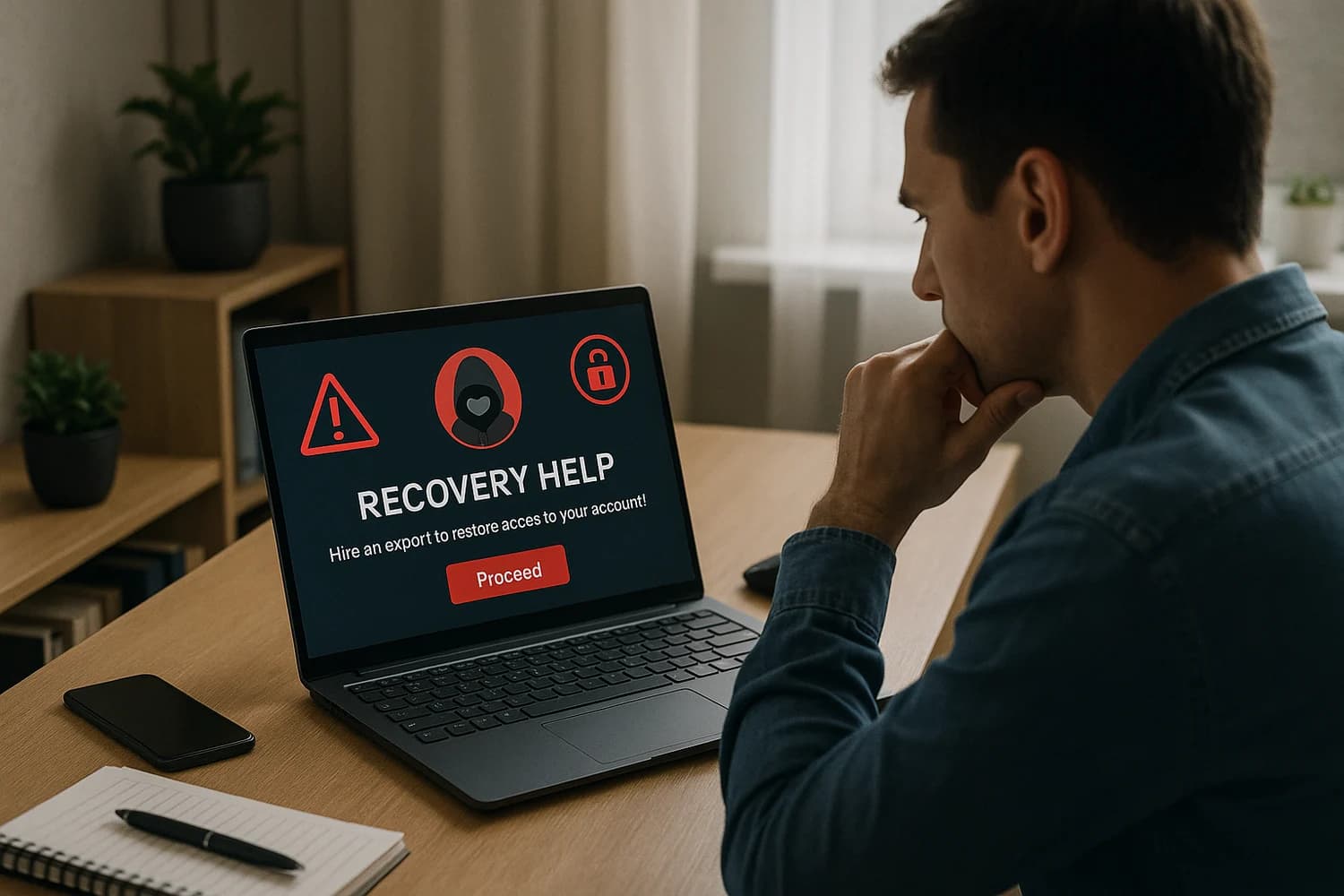
When people say “I want to hire a hacker”, they usually mean one of three things: regain access to an account, remove damaging content, or find out who attacked them. The problem is that most “hackers for hire” online are either scams, criminals, or both. Even when they deliver something, you inherit risk: extortion, legal exposure, and a new attacker who now knows your data and systems.
The safer path is not “do nothing”. It is to use official recovery channels, legitimate security professionals, and an incident-response process that preserves evidence and reduces repeat compromise.
Make the right first move
- Locked out of an account: use the platform’s official recovery flow, secure your email, and remove unknown sessions. Start with account recovery steps.
- Money missing or fraud: contact your bank or payment provider using official numbers, then secure your email and phone number recovery channels.
- Extortion or threats: preserve evidence and do not pay quickly. Focus on safety and official reporting channels.
- Business compromise: treat it as incident response. Contain, preserve evidence, and then remediate.
Do not: send passwords, MFA codes, ID photos, or remote-access sessions to strangers claiming they can “recover” accounts. That is how many takeovers get worse.
Why “hire a hacker” is a trap
1) Most offers are pure fraud
Common scam patterns:
- They take an upfront fee and disappear.
- They show fake “proof” screenshots and ask for more money.
- They ask you to install remote access software, then steal accounts and financial data.
- They claim “inside contacts” at platforms, then keep charging for “escalation”.
2) You can be extorted later
If you give a stranger access to your accounts or systems, they can copy data and threaten to leak it later. You have no leverage because the relationship is already illegal or non-contractual.
3) You create legal and reputational exposure
Even if you feel morally justified, “unauthorized access” is still unauthorized access. You can become the person who commissioned a crime. That risk often becomes real when something goes wrong and you need help from banks, platforms, insurers, or law enforcement.
4) You do not fix the root cause
Many lockouts happen because the attacker controls your email or phone recovery channel, or because you reuse passwords. A “hack back” does not repair those controls. The compromise returns.
Key idea: Recovery is mostly about control planes and evidence, not “secret techniques”. If your email and recovery channels are secure, most takeovers become recoverable through official flows.
What to do instead
Option A: Official account recovery
For consumer accounts, official recovery is the only path that does not create new risk. The fastest improvements usually come from:
- Securing email first.
- Resetting passwords from a clean device.
- Revoking unknown sessions and connected apps.
- Enabling strong sign-in protection.
Start with:
Option B: Incident response and forensics
If a business is compromised, you want a team that can contain and preserve evidence before rebuilding. That means legitimate incident responders and forensic specialists, not “hackers”. The goal is to answer:
- How did access happen?
- What data was exposed?
- What persistence exists?
- How do we recover without reinfection?
If your case involves ransomware, use the incident-first playbook in business attacked with ransomware. It is the same containment logic, just a different scenario.
Option C: Penetration testing
If your goal is to find weaknesses before an attacker does, use a reputable penetration testing firm with contracts, scope, and rules. Pen testing is authorized and controlled. “Hire a hacker” is not.
Option D: Reporting and documentation
If you were scammed or extorted, preserve evidence and report through official channels. Even if you never hear back, reporting can help connect cases and can support bank disputes.
- US reporting: FBI Internet Crime Complaint Center (IC3)
How to vet legitimate security help
When you are stressed, it is easy to accept the first confident person who promises results. Use a few simple filters:
- Contracts and scope: legitimate providers will define what they will do and what they will not do.
- No guarantees: they will set expectations and probabilities, not promise certainty.
- No request for your codes: they do not ask you to share MFA codes or passwords.
- Evidence-first approach: they will talk about preserving logs, documenting timelines, and controlling recovery channels.
| Red flag | What it usually means | Safer response |
|---|---|---|
| “We have insider access” | Scam or policy violation | Use official support flows and documented escalation |
| “Send your codes and we’ll fix it” | Account takeover attempt | Never share codes; secure email and sessions yourself |
| “Pay now or you lose it forever” | Pressure tactic | Pause and verify identity and legitimacy |
How to spot “recovery” scams quickly
- They ask for MFA codes: legitimate support does not need your codes.
- They want remote access: “I need to screen share” is a common takeover move.
- They promise guaranteed recovery: no one can guarantee platform outcomes.
- They pressure urgency: “pay now or you lose it forever” is often manipulation.
For the messaging patterns behind these scams, use how to identify scam emails and how to detect fake websites. The same verification habits apply.
The safer mindset
Wanting fast recovery is normal. The trick is to choose the path that makes the incident smaller, not bigger. Official recovery flows, evidence-first incident response, and legitimate security professionals reduce risk and improve outcomes. Uncontrolled “hacker for hire” shortcuts usually create a second incident layered on top of the first.
If you treat the recovery channel (email, phone, sessions) as the control plane and you run a calm process, you regain control more often than you expect. And you do it without inviting a new attacker into your life.