
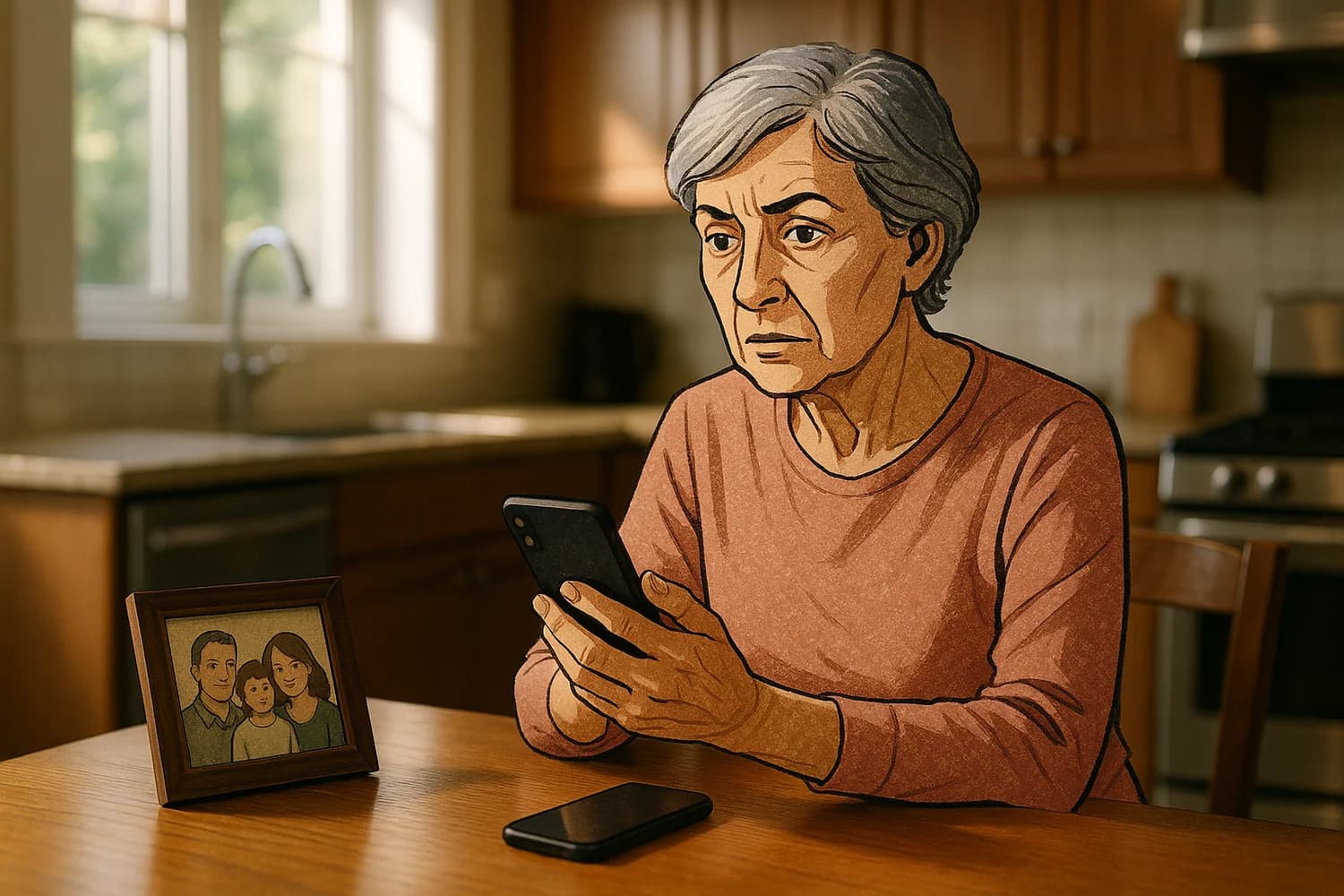
An AI grandkid ransom call is built to make you act before you verify. The scammer may use a cloned voice, a fake proof of life photo, or a text that says your grandchild is injured, arrested, or being held somewhere. The goal is not to convince you forever. The goal is to make you pay before your brain catches up.
The FTC warns that criminals now use AI voice cloning in family emergency scams, and the FBI warns that altered photos can be used as fake proof of life in virtual kidnapping schemes. For adults 50 and older, that matters because the attack is not only emotional. It is designed to break the one thing that slows fraud down, verification.
Key idea: voice is not proof. A familiar voice can be cloned from short audio clips, and a believable photo can be recycled from public social media images.
First 2 minutes
Do these steps in order. They are the fastest way to stop the scam from owning the pace.
- Do not send money. Not wire, not gift cards, not cash apps, not crypto.
- Call the grandchild on a known number. If that fails, call another family member immediately.
- Use the family code word if your family has one. If you do not, create one after this incident.
- Save the evidence. Screenshot texts, caller ID, voice notes, photos, payment instructions, and usernames.
- Keep the caller busy only if it helps verification. Do not let them isolate you from other family members.
- If you cannot verify safety quickly, call local emergency services. Treat it as a safety problem first, not a payment problem.
| What you hear or see | Best first move | Why |
|---|---|---|
| They say a grandchild is in danger | Hang up, call the grandchild on a known number, then call another relative | Urgency is the pressure tool. Verification breaks the script |
| The voice sounds exactly right | Do not trust the voice alone. Use a secret family word or another trusted channel | The FTC says AI can clone a loved one’s voice from short clips |
| A photo or video arrives as proof of life | Screenshot it before it disappears, then inspect the details | The FBI says scammers can alter public photos into fake proof of life media |
| They demand wire, gift cards, or crypto | Stop. If any payment happened, contact the bank or provider immediately | These payment methods are favored because they are hard to unwind |
What this scam looks like now
This is no longer just a bad actor yelling in the background of a phone call. The newer version can include AI-generated audio, deepfake or altered images, and timed messages that make you think you have only seconds to react. The FBI’s 2025 warning says criminals are using altered proof of life media in virtual kidnapping for ransom scams, which means the scammer may not need any real emergency at all.
That shift matters because the old advice, listen to the voice and judge whether it sounds familiar, is weaker now. The FTC warns that scammers use AI voice cloning to imitate family members, and the FBI says criminals can create believable videos or photos that look like they came from the real person. The machine is doing part of the impersonation work for them.
Rule of thumb: if the caller wants you isolated, silent, and rushed, the caller is managing your decision process. That is part of the scam, not a clue that it is real.
Look closely at the proof of life media if you receive it. The FBI says to watch for distorted hands or feet, unrealistic teeth or eyes, irregular faces, strange shadows, odd accessories, lag between mouth and voice, or movement that does not match a real person. In a photo, compare tattoos, scars, jewelry, body proportions, and background details against the last confirmed image you have.
One photo is not enough to confirm a kidnapping. One voice is not enough either. Real verification is a separate channel, a known number, or a family process that the scammer does not control.
How to verify without losing time
Verification should be fast, boring, and repetitive. Do not start by negotiating with the caller. Start by checking the person they claim is missing.
- Call the grandchild’s known phone number.
- Call the other parent, spouse, sibling, or close relative.
- Use the family code word if one exists.
- If the person is traveling, call the hotel, tour guide, school, or airport contact that you already have on file.
- If the caller says not to contact anyone else, treat that as evidence of manipulation.
If you still cannot verify safety, and the call feels credible, contact local emergency services or police. The point is not to escalate every scam to law enforcement automatically. The point is to avoid paying before you know whether anyone is actually in danger.
If the number is unknown, if the call starts with a recording, if the text arrives from a new number, or if the story keeps changing, slow down even more. Scams are often built from fragments, not a complete narrative. The less complete the story, the more you need to verify before you act.
If money is already being requested
Payment pressure is where the scam becomes expensive. The attacker may ask for a wire transfer, gift cards, cash app money, or cryptocurrency because those paths are difficult to reverse. The FTC says to treat requests for gift cards or crypto as a strong fraud signal, and the FBI says never send money to people you only know online or over the phone.
| Payment type | What to do immediately | What to expect |
|---|---|---|
| Wire transfer | Call the bank fraud line and ask for a wire recall or fraud review | Speed matters. Recovery gets harder once the transfer settles |
| Gift cards | Keep the receipts, card numbers, and store location, then report it | These are difficult to reverse, but the details still matter for reports |
| Crypto | Capture the wallet address, amount, exchange, and transaction ID, then report it | Recovery is uncertain, but a clean trail helps investigators and exchanges |
| Cash app or other peer to peer app | Use the app’s fraud flow and contact your bank if the bank card or account was used | Some transfers can be frozen, but not all can be reversed |
If you have not paid yet, do not "test" the caller with a small transfer. That still confirms you are responsive and can make the next demand more believable. Once the scammer knows the family is willing to pay, the asks often get more urgent and more specific.
Report it with a clean evidence packet
Reporting is more effective when you already have a small evidence packet. Save the phone number, time of call, text transcripts, screenshots, payment instructions, voice files, proof of life media, and any names used by the scammer. If the scam used a family member’s social media image or voice, save the public post or profile links too.
Then report the incident to the FBI’s Internet Crime Complaint Center and the FTC. IC3 is where you want the payment and contact details to land, especially if money was sent or a wallet address was used. The FTC helps document the scam pattern, which matters when the same method shows up again against other families.
- FBI IC3: ic3.gov
- FTC fraud reporting: reportfraud.ftc.gov
The FBI’s 2024 IC3 report gives the scale behind this advice. For people age 60 and older, IC3 recorded 147,127 complaints and $4.885 billion in losses overall, with 12,618 extortion complaints in that age group. That is not a niche problem. It is a repeat pattern that keeps working because it creates panic faster than verification can catch up.
Why older adults are targeted
Older adults are not targeted because they are careless. They are targeted because the attacker wants trust, concern for family, and enough savings or access to move money quickly. A grandparent answerable to a frightened voice is exactly the kind of pressure the scammer wants. The emotional hook is family, but the operational target is cash and account access.
That is also why the scam often starts with publicly available details. A social post about a trip, a grandchild’s name, a school event, a public photo, or an obvious family connection helps the attacker sound specific. The FBI says to limit online content of your image or voice, make social accounts private, and limit followers to people you know when possible. The less public material the scammer can reuse, the weaker the impersonation becomes.
How to cut off the next attempt
After the immediate incident, harden the family process. A good defense is not technical glamour. It is a routine that works under stress.
- Create a family code word and make everyone repeat it back.
- Decide which number counts as the real callback number for each person.
- Keep travel plans and live location updates off public social media until after the trip.
- Make social accounts private and trim followers to people you know.
- Reduce public voice clips, live videos, and posts that expose routines, schools, or family relationships.
If the scam started from a text message, the same family can usually benefit from a quick review of how to avoid SMS text scams. If the attacker knew a lot about the family, use reduce your digital footprint to remove the public scraps that make the next impersonation easier. If the threat came through email as well, review how to identify scam emails so urgent money requests get a slower, more disciplined response next time.
If the caller tried to keep you from talking to family or your own bank, that is social engineering, not a proof of danger. When the pressure is high, the safest default is to slow down, verify on a known channel, and treat every payment instruction as suspect until it survives a callback. The FBI’s guidance is simple on this point, hang up, verify the contact independently, and never send money or sensitive information to a person you have only met over the phone or online.
What to tell family now
Do not wait for the next emergency to define the rules. Tell the family in plain language that any urgent request for money, secrecy, or a new phone number has to pass a callback test. If someone cannot answer the family code word, or if the caller refuses a callback on a known number, the family stops and verifies before anyone pays.
That single rule changes the economics of the scam. The attacker can still call. The attacker can still imitate a voice. The attacker can still send a fake photo. What the attacker cannot easily fake is a shared family verification habit that ignores panic and checks a second channel first.
Virtual kidnapping succeeds when the scammer gets to own the pace, the tone, and the separation between people. Once the family has a verification path, the caller loses the advantage. Once the payment rails are covered, the incident stops becoming a hidden transfer and becomes a documented fraud event. That is the point where the scam starts to fail.
The safest families are not the ones that never receive a frightening call. They are the ones that already decided what frightening calls mean. If that rule exists before the scam arrives, the voice in the phone no longer gets to decide what happens next.